Healthy Aging • Strength • Women 40+
Creatine for women over 40 is getting much more attention, but the useful question is not whether creatine is “for women.” It is whether a simple, well-studied supplement can support strength and lean mass when it is paired with the habits that matter most: resistance training, enough protein, sleep, and consistency.
Affiliate disclosure: As an Amazon Associate, Vital Harmony Fit may earn from qualifying purchases. Product availability and prices can change.
Why creatine is suddenly part of the women-over-40 conversation
For years, creatine was marketed almost entirely to male bodybuilders. That made many women assume it was only useful if the goal was to get bigger. The research conversation is much broader now. Creatine helps the body maintain a small pool of rapidly available energy in muscle cells, which is especially useful during repeated, high-intensity efforts such as resistance training.
That matters after 40 because preserving muscle and strength becomes more important with age. Hormonal changes around menopause can overlap with changes in training recovery, lean mass, body composition, and bone health. Creatine is not a menopause treatment, and it is not a replacement for strength training. But it may be a useful addition to a strength-focused routine.
A 2026 systematic review and meta-analysis of seven randomized trials involving 608 postmenopausal women found that creatine supplementation modestly increased lean mass and improved leg-press strength. The strongest signal appeared when at least 5 grams per day was combined with resistance training. The review did not find a clear overall benefit for bone mineral density, so creatine should not be sold as a “bone-building” shortcut.
What creatine actually does
Your muscles use adenosine triphosphate, or ATP, for immediate energy. During short bursts of hard effort, ATP is used quickly. Creatine helps support the phosphocreatine system that regenerates ATP. That is why the clearest benefits are seen in repeated high-intensity work such as lifting, sprinting, or repeated hard intervals.
Over time, being able to perform a little more training volume or maintain better output can support strength and lean-mass goals. Creatine also pulls some water into muscle cells. That is one reason body weight can rise slightly after starting it. This is not the same thing as gaining body fat.
Creatine for women over 40: what the research says
The evidence is promising but should be described accurately. The newest postmenopausal meta-analysis found a small average increase in lean mass and a meaningful improvement in leg-press strength. Trials using creatine with resistance training performed better than lower-dose trials without structured training.
Another review focused on women across different life stages concluded that creatine can support strength, exercise performance, and body composition, while also pointing out that research in perimenopausal women remains limited. That is an important caveat. A woman who is 42 and perimenopausal is not identical to a 62-year-old postmenopausal participant in a trial.
For practical purposes, the best-supported message is simple: creatine monohydrate can be a reasonable option for healthy adults who want to support resistance-training performance and muscle maintenance, but it works best as part of a broader routine.
How much creatine do women over 40 usually take?
Most straightforward daily routines use about 3 to 5 grams of creatine monohydrate per day. Many products provide 5 grams per scoop. A loading phase can saturate muscle stores faster, but it is not required for most people. Daily consistency matters more than perfect timing.
If you are taking creatine for the first time, the simplest approach is usually the easiest to maintain: one clearly measured serving each day, mixed into water, a smoothie, or another drink.
- Look for creatine monohydrate as the main ingredient.
- Check how many grams you get per serving.
- Do not assume a “women’s formula” is better just because it contains more ingredients.
- Compare cost per 5-gram serving, not just the price of the tub.
- Choose a format you can take consistently.
- If you have kidney disease, are pregnant, or take medications that affect kidney function, discuss supplementation with your clinician first.
Will creatine make you bulky?
No supplement can make someone suddenly “bulky.” Significant muscle growth requires progressive training, enough calories, adequate protein, and time. Creatine may help training quality and can slightly increase water stored inside muscle cells, which may make muscles look a little fuller. That is very different from rapidly adding large amounts of muscle.
For many women over 40, the more useful goal is not maximum size. It is maintaining strength, independence, and enough lean mass to keep doing the activities that matter.
Does creatine cause bloating or weight gain?
Some people notice a small increase on the scale after starting creatine because more water is stored inside muscle tissue. That is not body-fat gain. Digestive discomfort is more likely when very large amounts are taken at once, which is another reason a simple daily dose is often easier to tolerate.
If bloating or stomach upset occurs, check the serving size and the rest of the formula. Gummies and flavored powders can contain sweeteners, sugar alcohols, acids, or other ingredients that may be responsible for the discomfort rather than creatine itself.
Powder, capsules, or gummies?
| Format | Best for | What to watch |
|---|---|---|
| Powder | Value, simple formulas, flexible dosing | Requires mixing and measuring |
| Capsules | Travel and no-mix convenience | You may need several capsules to reach a full daily serving |
| Gummies | Convenience and taste | Check grams per serving, sugars, and added ingredients |
For most buyers, plain creatine monohydrate powder remains the easiest product to compare. It also keeps the ingredient list short, which makes it easier to know exactly what you are taking.
If you want a deeper comparison, see our guide to creatine gummies vs powder.
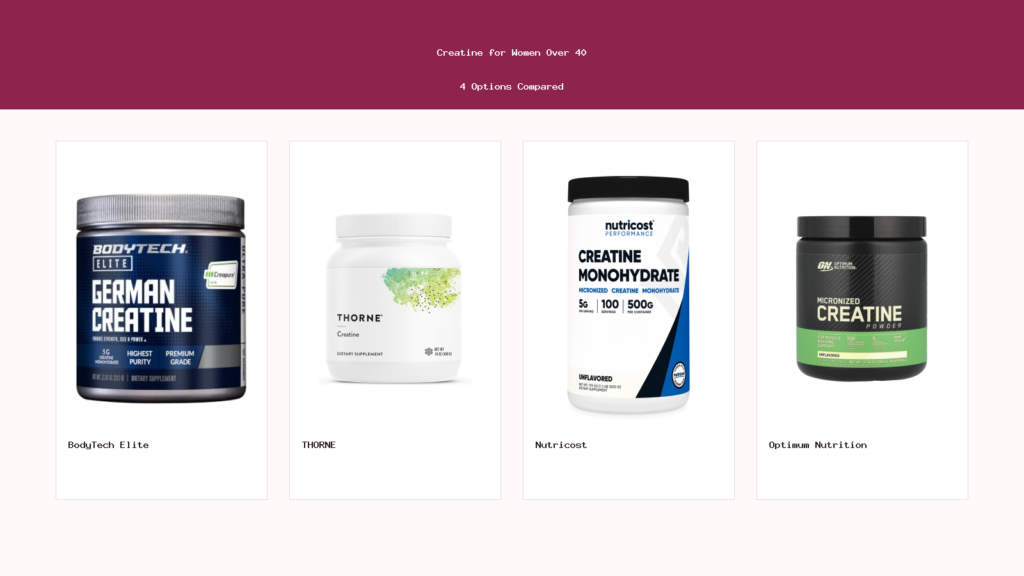
Three creatine options worth comparing
These are not ranked as medical recommendations. They are examples of straightforward creatine products with clear positioning so you can compare formula, certification, and value.
BodyTech Elite German Creatine with Creapure

Why compare it: A simple creatine powder built around Creapure-branded creatine monohydrate. It is a useful benchmark if you prefer a formula centered on one familiar form of creatine.
THORNE Creatine
ASIN: B07978VPPH
5 g creatine monohydrate per serving and NSF Certified for Sport. A premium choice for buyers who care about third-party sport certification.
Nutricost Creatine Monohydrate
ASIN: B00GL2HMES
5 g per serving in a straightforward micronized monohydrate powder. A strong value comparison when cost per serving matters.
Optimum Nutrition Micronized Creatine
ASIN: B002DYIZEE
5 g creatine monohydrate per serving in a widely used unflavored powder. Good for buyers who want a familiar sports-nutrition brand.
What should you look for before buying?
The front label matters less than the Supplement Facts panel. A product can say “for women,” “healthy aging,” or “beauty creatine,” but the first question is still how much creatine monohydrate is actually in a serving.
Also check whether the serving size is realistic. A gummy might advertise 5 grams, but that could require several gummies. A capsule formula might require four or more capsules to reach the same amount found in one scoop of powder.
Third-party testing can also be useful, especially for athletes subject to drug testing. Certifications do not make creatine itself more effective, but they can add another layer of quality control.
When should you take creatine?
The exact time of day is less important than taking it consistently. Some people add it to a morning smoothie. Others mix it into a post-workout drink or take it with lunch. Choose the time you are most likely to remember.
If you already use a protein shake after resistance training, adding plain creatine monohydrate can make the routine simple. There is no requirement that creatine and protein be taken together, but combining them in one established habit can improve consistency.
Who should be more cautious?
Healthy adults generally tolerate creatine monohydrate well in research, but personal context matters. If you have kidney disease, are pregnant or breastfeeding, use medications that affect kidney function, or have been told to limit supplements for a medical reason, talk with your healthcare professional before starting.
Also remember that creatinine, a blood marker used in kidney testing, is related to creatine metabolism. Supplement use can sometimes complicate interpretation of lab results. Tell your clinician that you use creatine if you are having kidney-related bloodwork.
Bottom line
Creatine for women over 40 is not a magic menopause supplement, and it is not only for bodybuilders. The strongest practical case is for women who are doing resistance training and want an evidence-based way to support strength and lean-mass goals.
Keep the product simple, check the actual grams per serving, and build the supplement around the routine rather than expecting the supplement to replace it. For most buyers, plain creatine monohydrate is still the place to start.
Sources: 2026 systematic review and meta-analysis of creatine in postmenopausal women: PubMed. Review of creatine across women’s life stages: PubMed. Product facts were checked against current manufacturer pages and Amazon listing identifiers. This article is educational and is not medical advice.