
If you are staring at two tubs labeled EAA and BCAA and wondering which one actually makes sense, start with what the names mean rather than the marketing. The key question is whether you need three branched-chain amino acids, all of the essential amino acids, or simply enough complete protein from food.
Quick answer: BCAAs provide three essential amino acids—leucine, isoleucine and valine—while a complete EAA formula provides all nine essential amino acids. If your goal is muscle growth or recovery, the bigger question is whether your total diet already supplies enough complete protein and essential amino acids.
Before you buy: check your daily protein intake, your training goal, the full Supplement Facts panel, serving size, sweeteners and cost per serving. Many people already get plenty of essential amino acids from food, so a supplement is not automatically necessary.
EAA vs BCAA: the short version
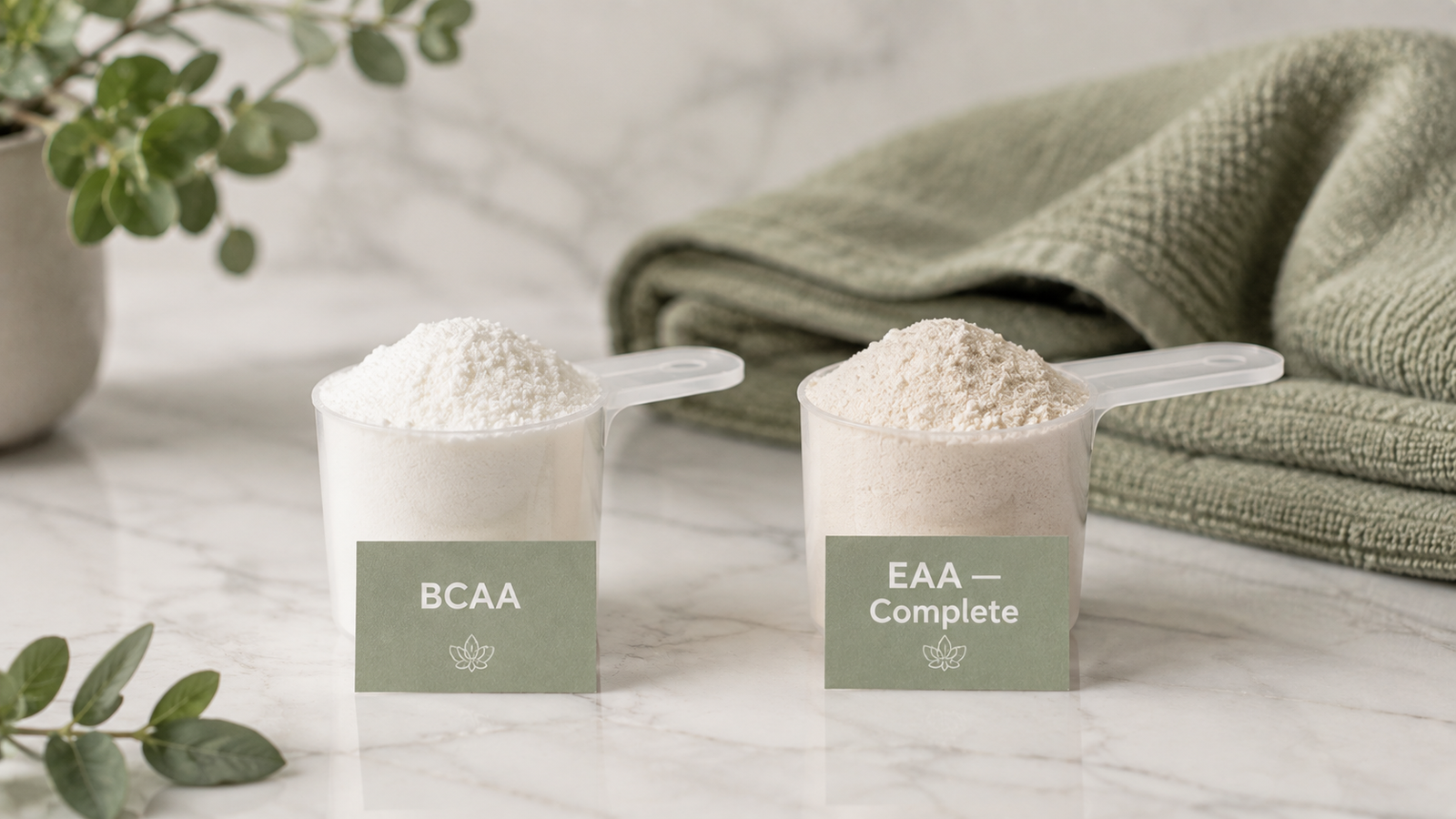
BCAAs are three essential amino acids: leucine, isoleucine and valine. The full EAA group contains nine essential amino acids that must come from the diet. BCAAs are therefore a subset of EAAs. A BCAA-only supplement does not provide the other six essential amino acids, although those can still come from meals eaten during the day.
Why leucine alone isn’t enough
Leucine gets most of the attention because it acts as a trigger — it helps activate mTOR, the cellular pathway responsible for kicking off muscle protein synthesis. This is sometimes called the “leucine threshold,” and it’s the reason BCAA marketing leans so heavily on leucine content. But triggering the process and completing it are two different things. Once that mTOR pathway is switched on, your body still needs the other essential amino acids as raw material to actually build the new muscle protein. Leucine can start the engine, but it can’t finish the job by itself.
That is the key limitation of looking at BCAAs in isolation: leucine can participate in the signaling process, but muscle protein synthesis also depends on the availability of the other essential amino acids.
What a complete EAA formula adds

A complete EAA formula should identify all nine essential amino acids: histidine, isoleucine, leucine, lysine, methionine, phenylalanine, threonine, tryptophan and valine. Food sources of complete protein can also provide this full group, which is why a supplement is not automatically necessary when protein intake is already adequate.
Quick comparison
| BCAA | Complete EAA | |
|---|---|---|
| Amino acids included | 3 (leucine, isoleucine, valine) | All 9 essential aminos |
| Triggers muscle protein synthesis | Yes (via leucine) | Yes |
| Provides raw material to complete synthesis | Partially | Provides all 9 EAAs in the formula |
| Best for | People specifically choosing a 3-amino blend | People who want all essential amino acids in one formula |
EAA vs BCAA: what matters more than the label on the tub
The biggest question is not which acronym sounds more advanced. It is whether your overall diet already supplies enough complete protein. If it does, the difference between an EAA and BCAA supplement may matter much less than marketing suggests. If protein intake is inconsistent, a complete EAA formula provides a broader amino acid profile than BCAAs alone.
EAA vs BCAA for muscle growth and recovery
For muscle growth, resistance training and adequate total protein matter more than choosing a supplement by acronym. BCAAs include leucine, which is involved in signaling muscle protein synthesis, but building new muscle protein also requires the other essential amino acids to be available. A complete EAA formula supplies all nine in one serving, while a BCAA formula supplies only three.
For workout recovery, the same principle applies: first look at your overall protein intake, meal timing, training load and recovery habits. If those basics are already covered, adding BCAAs may offer less practical value than the label suggests. If your diet is low or inconsistent in complete protein, an EAA product provides a broader amino acid profile—but it still does not replace a balanced diet.
EAA vs BCAA for adults over 40
As adults get older, preserving muscle becomes increasingly important. Protein intake and resistance training remain the foundation. An amino acid supplement may be convenient for some people, but it should be evaluated as an addition to those basics rather than a substitute for them. If you are comparing EAA and BCAA products after 40, focus on the complete amino acid profile, serving size, total daily protein intake and whether the product actually fills a gap in your diet.
Who this matters most for

If you’re eating plenty of complete protein throughout the day — meat, eggs, dairy, or a well-planned combination of plant proteins — your diet is likely already supplying the other six essential aminos a BCAA supplement leaves out. In that case, the gap matters less. But for people training in a fasted state, recovering from intense or frequent workouts, or simply not consistently hitting their daily protein targets, relying on BCAAs alone leaves a real gap between what’s being triggered and what’s actually available to finish the job.
With age, maintaining adequate protein intake and resistance training becomes especially important. If you are worried about age-related strength changes, read our muscle loss after 50 guide before assuming an amino acid supplement is the missing piece.
Common EAA vs BCAA questions before choosing either one
Do BCAAs build muscle by themselves? Not by themselves. Muscle growth depends on resistance training, enough total energy and availability of all essential amino acids.
Do you need BCAAs during every workout? Not necessarily. For many people who already meet their protein needs, the extra benefit may be small.
Is an EAA automatically better? It is more complete as an amino acid formula, but that does not mean every person needs one. Diet quality, protein intake, serving size and cost still matter.
How to read an EAA or BCAA supplement label
Check whether all nine essential amino acids are listed, how much is provided per serving, whether amounts are disclosed clearly, what sweeteners or other ingredients are included, and how many servings the container provides. Do not rely on a front-label phrase such as “complete” without checking the Supplement Facts panel.
EAA vs BCAA: the bottom line
BCAAs provide three essential amino acids; a complete EAA formula provides all nine. Whether that difference matters enough to justify a supplement depends on what your diet already provides. Start with your protein intake and goal, then compare the label rather than choosing by acronym alone.
FAQ
Can I take BCAAs and still get all nine EAAs from food? Yes, if your overall diet includes enough complete protein sources throughout the day. The gap mainly shows up when diet alone isn’t consistently covering it.
Is more expensive always better when it comes to EAA supplements? Not necessarily — what matters is whether the formula actually includes a complete, well-balanced profile of all nine essential aminos, not just the price tag.
Do EAA supplements work differently for older adults? The underlying mechanism is the same, but aging muscle can be less responsive to amino acid signaling, which is part of why complete formulas — rather than leucine-heavy BCAA blends alone — tend to be recommended more specifically for older adults.
This article is for informational purposes only and is not medical advice. If you want to apply this checklist to one specific amino acid product, our Advanced Amino buying guide reviews the current product presentation after the EAA/BCAA distinction is clear.
nnCompare complete EAA profiles and serving costs; do not assume BCAAs contain all essential amino acids.
View Thorne Amino Complex on Amazon →As an Amazon Associate, VitalHarmonyFit may earn from qualifying purchases.