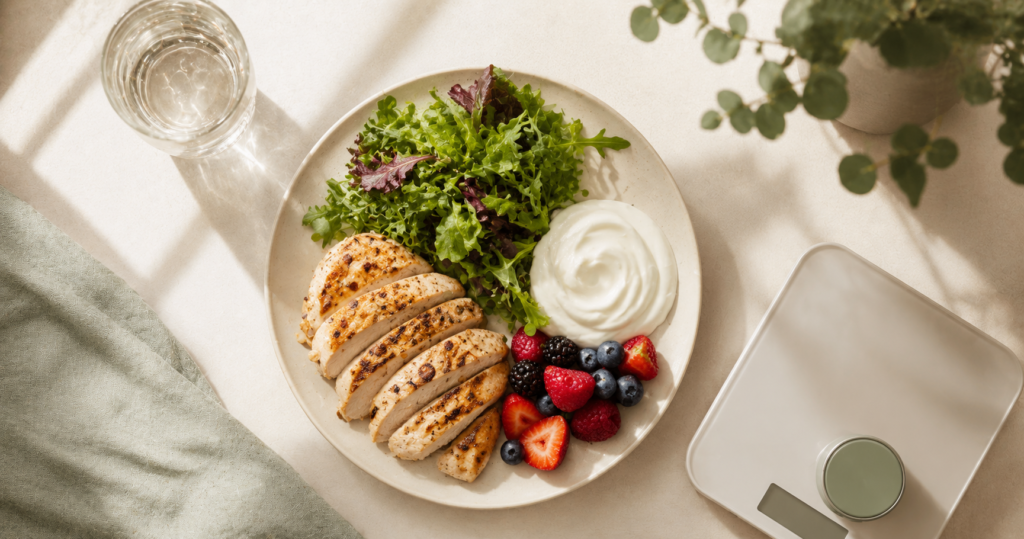
If you’re wondering what to eat on GLP-1 medication, you’re not alone. GLP-1 medications — the category that includes semaglutide (Ozempic, Wegovy) and tirzepatide (Mounjaro, Zepbound) — have become one of the most talked-about health topics in the U.S…
These medications work by dramatically reducing appetite, which is exactly the point — but it creates a new problem. When you’re eating a fraction of what you used to, it becomes much harder to get oganize what to eat on GLP-1 medication to ensure enough protein, fiber, and essential micronutrients. Without a plan, this can lead to muscle loss, fatigue, and nutrient gaps if your diet isn’t adjusted intentionally.
This isn’t medical advice on the medication itself — that conversation belongs with your prescribing doctor. But here’s what the nutrition science says about supporting your body while your appetite is suppressed.
Essential Nutrition: What to Eat on GLP-1 Medication
The #1 Priority: Protecting Your Muscle Mass
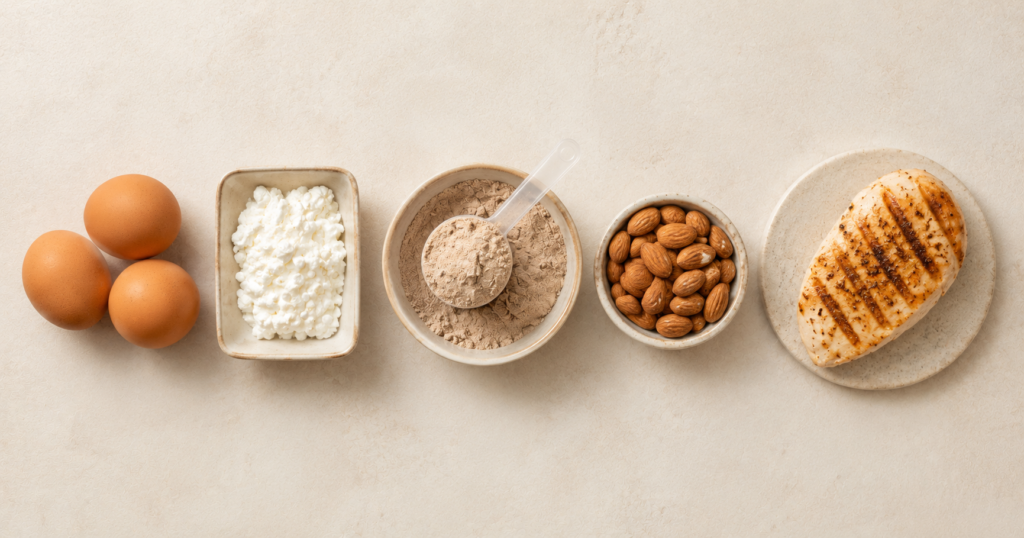
Rapid weight loss from any source — including GLP-1 medications — doesn’t just burn fat. Knowing what to eat on GLP-1 medication is crucial because without enough protein and resistance training, a significant portion of that weight loss can come from lean muscle, which is the opposite of what most people actually want. Less muscle also means a slower metabolism over time.
What tends to help:
- Prioritizing protein at every meal, even small ones — aim to hit protein before filling up on anything else
- Clinical nutrition guidance often points toward roughly 1.2–2.0 grams of protein per kilogram of body weight daily for people on GLP-1 medications, though individual needs vary
- Since appetite is limited, many people find it easier to hit that number with efficient sources: eggs, Greek yogurt, cottage cheese, lean meats, and protein powders
- Pairing meals with light resistance training (even bodyweight exercises) to help preserve muscle during the weight loss
Fiber: The Nutrient Most People Forget
Ironically, one of the most common side effects of GLP-1 medications — constipation and digestive discomfort — is often made worse by low food intake. When considering what to eat on GLP-1 medication, fiber must be a top priority to maintain regularity.
What tends to help:
- Choosing fiber-dense foods over empty calories when appetite is limited: berries, chia seeds, oats, leafy greens
- Staying consistently hydrated, since fiber without enough water can worsen constipation, not fix it
- Some people use a fiber supplement (like psyllium husk) to close the gap when whole food intake is very low
The Micronutrient Gaps to Watch
When someone goes from eating three full meals to a few small ones, certain vitamins and minerals are the first to fall short — even if calories are still “enough” on paper. Deciding what to eat on GLP-1 medication should include a focus on nutrient density.
The nutrients most commonly discussed in this context include:
- Vitamin B12 — important for energy and nerve function, and often lower in people eating less overall
- Vitamin D — commonly low in the general population, and even more so with reduced food variety
- Iron — especially relevant for those eating less red meat or animal protein
- Magnesium — supports muscle function, sleep, and energy, and is easy to under-consume on a reduced-calorie intake
- Electrolytes (sodium, potassium) — worth paying attention to if nausea or reduced fluid intake is an issue
A daily multivitamin is often suggested as a simple baseline, but it shouldn’t be treated as a replacement for actual food — think of it as filling the cracks, not the whole floor.
Probiotics and Gut Support
Digestive side effects (nausea, bloating, irregularity) are among the most commonly reported issues with GLP-1 medications. Some people find that a probiotic, alongside slower eating and smaller, more frequent meals, makes a noticeable difference in comfort — though individual response varies quite a bit here.
A Simple Daily Framework

If your appetite is limited, structure beats willpower. A framework some people find useful for what to eat on GLP-1 medication:
- First bite of every meal = protein. Not because carbs are “bad,” but because protein is the easiest thing to under-eat when you’re full quickly.
- One fiber source per meal, even a small one.
- Water before food, not with it — nausea is often worse on an empty, dehydrated stomach.
- A basic multivitamin as a daily safety net.
- Movement, not just cardio — a couple of short resistance sessions a week to protect muscle.
The Bottom Line
GLP-1 medications are a tool, not a full nutrition plan on their own. The people who tend to feel best on them — and keep the results long-term — are the ones who treat the reduced appetite as an opportunity to eat more intentionally, not just less. Protein, fiber, and a handful of key micronutrients are doing a lot of the heavy lifting behind the scenes.
This article is for informational purposes only and does not constitute medical advice. If you are taking GLP-1 medication, work with your doctor or a registered dietitian to build a nutrition plan suited to your specific needs.
This article is for informational purposes only and is not a substitute for professional medical advice. Consult your doctor before starting any new supplement.
How to use this information in a realistic routine
It helps to treat health and supplement decisions as part of a bigger routine rather than as a single quick fix. Start with the basics that apply to the topic, keep changes simple enough to repeat, and give yourself time to notice whether the routine is actually practical. If a product is involved, compare the label, serving size, ingredient amounts, allergens and cost per serving instead of relying only on front-label claims.
For symptoms that are persistent, severe, new or getting worse, a clinician can help rule out causes that a wellness article cannot diagnose. That is especially important when symptoms overlap with medication effects, hormonal changes, digestive conditions or other health concerns. The goal is not to chase every trend; it is to make a sensible decision with clear expectations.
A simple check before you change your routine
- What specific problem are you trying to solve?
- Is the change realistic enough to repeat for several weeks?
- Are there medications, allergies or medical conditions to consider?
- Can you measure progress without relying on exaggerated promises?
- Would food, sleep, movement or professional care matter more than a supplement?


When appetite is lower, food quality matters more
People using GLP-1 medications may find that large meals are less appealing. That makes it useful to prioritize protein-rich foods, vegetables, fruit, whole grains or other fiber sources, and adequate fluids in portions that are comfortable. Individual needs vary, and medication side effects or nutrition concerns should be discussed with the prescribing clinician.
Practical meal planning on GLP-1 therapy
Smaller meals can still be nutritionally useful when they include a protein source, produce and a fiber-containing carbohydrate or healthy fat that is tolerated. Keeping simple foods available can make it easier to eat enough when appetite is low. If nausea, vomiting, dehydration or inability to eat becomes significant, contact the prescribing team rather than trying to fix the problem only with supplements.