Buying Guide • Creatine • 2026
Creatine Gummies vs Powder: Which Is Actually Better?
If strength, workout recovery or maintaining muscle has become more important in your 40s or 50s, creatine may start showing up in your searches. Gummies look easier, while powder has the longer research history. Here is how to compare dose, cost, convenience, ingredients and everyday use without assuming either format is automatically better.
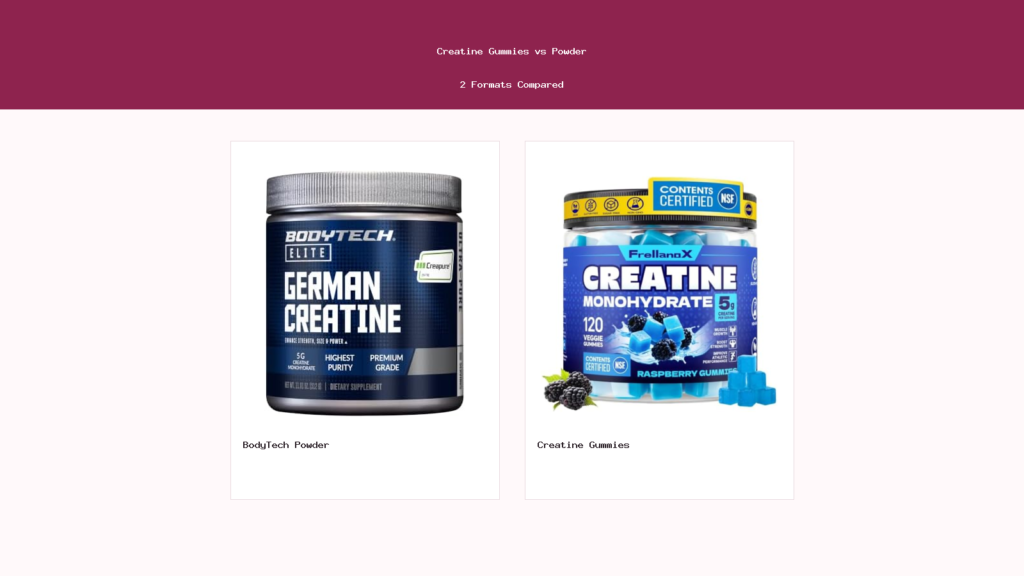
Best for value, simple ingredients and flexible dosing.
Best for portability and a routine you will actually remember.
1. Why Creatine Gummies Are Suddenly Everywhere
Creatine gummies vs powder has become a much bigger buying question than it was a few years ago. Creatine is no longer just a bodybuilding supplement. Interest has broadened to women, healthy-aging audiences and people who simply want a convenient daily performance supplement.
Search intelligence published in 2026 found creatine gummies drawing very strong U.S. search interest. That does not mean gummies are scientifically superior. It means consumers are increasingly interested in the format. If you are new to the ingredient itself, start with our guide to creatine for women and benefits beyond muscle.
2. Powder Is Still the Benchmark
Creatine monohydrate powder has the deepest research history. The NIH Office of Dietary Supplements notes that creatine is among the most thoroughly studied sports-performance supplements and that typical maintenance protocols often use about 3–5 grams per day.
Powder is simple: one ingredient, one scoop, and usually very little else. That makes products easier to compare and servings easier to adjust.
Affiliate disclosure: As an Amazon Associate, we earn from qualifying purchases.

Selected because it matches the supplement form discussed in this guide. Check the current label, size and availability on Amazon.
Lower cost per gram, easy dose adjustment, fewer added ingredients and a large research base.
You need a drink, a scoop and a little planning. Some people dislike the texture.
3. Gummies Win on Convenience, Not Automatically on Effectiveness
Gummies solve a real adherence problem. A supplement only helps as part of a routine if you actually take it. For someone who travels often, hates mixing powders or already uses a daily gummy routine, convenience has real value.
But gummies introduce extra variables. Check how many gummies make one serving, how many grams of creatine that serving actually provides, and what else comes with them, such as sugars, sugar alcohols and flavoring agents.

Selected because it matches the supplement form discussed in this guide. Check the current label, size and availability on Amazon.
4. Does One Absorb Better?
There is not strong evidence showing that a gummy format is inherently more effective than creatine monohydrate powder. What matters more is whether the product delivers the amount stated on the label and whether you take it consistently.
The NIH describes creatine monohydrate as the most widely used and studied form. More expensive alternative forms have not been proven superior for raising muscle creatine or improving performance outcomes.
5. The Biggest Difference Is Dose per Serving
This is where shoppers can get tripped up. A powder may provide several grams in a single scoop. A gummy product might require multiple pieces to reach its full labeled serving.
When comparing creatine gummies vs powder, do not compare one scoop with one gummy. Compare the grams of creatine per full serving, the number of servings per container and the real cost per serving.
6. Quality and Third-Party Testing Matter
This matters with any supplement, and even more when a category becomes trendy quickly. Look for clear labeling, a recognizable manufacturer and independent testing when available.
Certifications such as NSF Certified for Sport or Informed Sport can add another layer of quality assurance for athletes, though not every good product carries one.
7. Creatine Gummies vs Powder: Side-by-Side
| Factor | Powder | Gummies |
|---|---|---|
| Convenience | Good | Excellent |
| Dose flexibility | Excellent | Limited |
| Added ingredients | Often minimal | Usually more |
| Cost per gram | Usually lower | Usually higher |
| Travel friendly | Fair | Excellent |
Which Is Better for Women?
Women do not automatically need a different form of creatine. The bigger questions are dose, consistency, tolerance, cost and product quality. Gummies marketed specifically to women may have attractive packaging or added ingredients, but that does not make the creatine itself fundamentally different.
For women in midlife who are focused on preserving strength and lean mass, our article on muscle loss after 50 explains why resistance training and adequate nutrition matter more than choosing a trendy supplement format.
Choose powder if…
- You want the lowest cost per serving.
- You prefer a simple ingredient list.
- You want easy control over dose.
- You already mix smoothies or shakes.
Choose gummies if…
- You travel frequently.
- You forget powder-based supplements.
- You strongly dislike mixing creatine.
- You found a transparently labeled product you trust.
Our Take
Creatine gummies are not automatically a gimmick, and powder is not automatically the only smart choice. The best format combines correct labeling, a practical dose, reasonable cost and consistency.
For most value-focused shoppers, plain creatine monohydrate powder remains hard to beat. For someone who will actually take gummies every day but leave a tub of powder untouched in the cabinet, convenience may be worth paying for.
For most shoppers, powder wins on value and simplicity. Gummies can still be a smart buy when convenience is what keeps the routine consistent.
FAQ
Can women over 50 take creatine?
Age or sex alone does not determine whether creatine is appropriate. Women over 50 who are considering it should look at the product form, serving amount, overall diet, training routine and medical history. Anyone with kidney disease, pregnancy or breastfeeding, regular medications or other health concerns should speak with a qualified healthcare professional before use.
Do creatine gummies work?
They can, provided they contain the stated amount of creatine and you use an appropriate daily serving consistently.
Are creatine gummies better for bloating?
Not necessarily. Water-weight changes associated with creatine are related to the creatine itself rather than simply whether it comes in powder or gummy form.
Is creatine monohydrate still the best form?
It remains the most studied form and is the benchmark used in a large amount of the research.
Do I need a loading phase?
A loading phase can saturate stores faster, but it is not required. Lower daily dosing over a longer period can reach the same general endpoint.
This article is for educational purposes only and is not medical advice. Talk with a qualified healthcare professional before starting a supplement if you have kidney disease, are pregnant or breastfeeding, take medications, or have other medical concerns.